

On top of the gender pay gap, 72% of UK music professionals, performers and visual artists freelancers and 31.7% of EU-27 cultural and creative workers are self-employed (compared with 13.6% for the economy as a whole). With this comes fewer social protection and financial stability.
Additionally, the median gender pay gap is reported to be at 24.3% between male and female identifying artists and professionals within the industry (compared with 12.7% for the economy as a whole in the EU-27). While the gap has been steadily diminishing and more efforts have been made to reduce it, legislative change is encouraged more than ever before to enforce accountability.
In this International Perspectives, we look to the recent EU Transparency Directive that has come into effect to further gender pay equity through transparency and stronger enforcement. Practically tackling the gender pay gap will be interrogated further on a national level as we take insights from collecting societies Sacem (France) and PRS for Music (UK), the latter giving us a non-EU perspective. We take a deeper dive with PRS for Music, highlighting their latest Gender and Ethnicity Pay Gap Report (headed by Suzanne Hughes, Chief People and Transformation Officer). We then head over to Sacem for an interview with Fabienne Gestin (Human Resources Director), who delves into the French experience whilst reflecting on the complexities and challenges companies may face in enforcing the EU Transparency Directive.
The EU Transparency Directive and the Gender Pay Gap
Whilst equal pay has been mandated in the EU since 1958, to guarantee “equal pay for equal work”, its enforcement has been tricky to implement across the decades. Through identifying “institutional secrecy” being at the core of the lack of transparency around salaries and negotiations it was inevitable, therefore, that pay transparency lies at the heart of the new measures of the EU Transparency Directive.
This implementation of the Directive will see a shift in how job roles are to be advertised, how negotiations are made, and turning the tables to the employer instead to be transparent with the roles and salary. The onus is now on the employer to provide this clarity, criteria and salary justification to both current and prospective employees. Applicants no longer have to share their previous salaries, with candidates being privy to the salary prior to attending interviews. These are just some of the changes that mark a practical shift in gender pay equity.
And of course, we cannot talk about the directive without reminding ourselves of the stark gender pay gap across the EU nations that continues to persist:
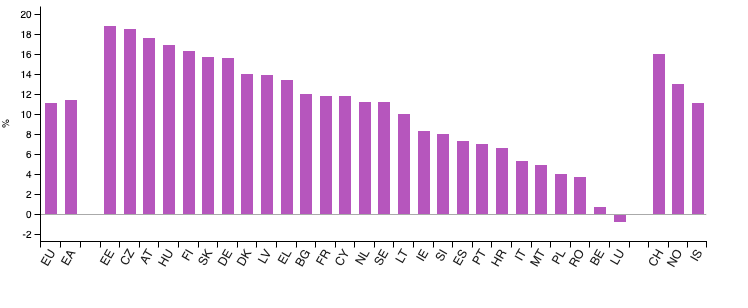
Source: Eurostat (online data code: sdg_05_20)
SPOTLIGHT: PRS for Music
The UK requirements for larger companies (250+) to declare their pay snapshots has been in force for the last decade. In addition to tracking this, PRS for Music has also been measuring the ethnicity pay gap, as well as breaking down what these gaps look like from all levels of the workforce, crucially including leadership positions. This further highlights the complexities that go beyond just gender pay gap overall.
With the latest Gender and Ethnicity Pay Gap Report. Suzanne Hughes (Chief People and Transformation Officer) notes:
“Pay equity remains one of the most important measures of our commitment to fairness and inclusion at PRS. This year’s report presents a mixed picture – we have made meaningful progress in some areas while recognising we’ve lost ground in others. Achieving pay equity is not a linear journey – it needs constant attention to build momentum and course correct when impact of our interventions is slower than planned. We will be resilient in refreshing our plans this year to respond to these latest figures.”
And so we take a closer look at successes, challenges (and tips!) for gender pay equity with PRS for Music:
What do you see as the biggest factor driving changes in the gender and ethnicity pay gaps?
The most significant factor influencing changes in our pay gaps continues to be representation across different levels of the organisation, particularly at senior leadership level. While recruitment plays an important role, sustainable progress comes from improving progression, development and retention of diverse talent throughout the organisation.
We are focused on creating more inclusive recruitment and talent processes, strengthening our approach to EDIB, and improving transparency through voluntary ethnicity pay gap reporting. These interventions, combined with broader workforce movements, have helped us build a stronger pipeline of diverse talent and better understand where barriers remain.
What concrete steps are you taking to improve progression into leadership roles, and how will you measure success?
We recognise that improving representation in leadership is critical to reducing pay gaps over time. Our focus is on ensuring access to development opportunities, mentorship, sponsorship/endorsement and succession planning.
We are strengthening inclusive talent and recruitment practices, reviewing career progression pathways, and encouraging diverse representation in leadership development programmes. Success will be measured through improvements in representation at senior levels, promotion rates across different demographic groups, employee engagement data and, ultimately, a reduction in our pay gaps over time.
Which learning initiatives have delivered measurable results, and which have yet to have the impact you expected?
Our learning initiatives are designed to increase awareness, build inclusive leadership capability and support equitable decision-making. Programmes focused on inclusive recruitment, unconscious bias awareness and inclusive leadership have helped strengthen conversations around equity and representation across the organisation.
We also recognise that learning alone does not drive change. The greatest impact comes when learning is combined with accountability, data and practical action. Some initiatives are still relatively early in their journey and require longer-term measurement to fully assess their impact.
What improvements should employees, members and the wider music industry expect to see next year, and what targets are you prepared to be held accountable for?
We remain committed to transparency and continuous improvement. Stakeholders should expect to see continued focus on increasing representation across all levels of the organisation, further strengthening inclusive recruitment and progression practices, and maintaining robust reporting on both gender and ethnicity pay gaps.
Rather than focusing on a single measure, we believe accountability should be assessed through a combination of representation, progression, retention, pay gap trends and in-depth analysis of the employee engagement survey. We want to demonstrate sustained progress through data and meaningful organisational change rather than short-term interventions.
What barriers have you identified that prevent a more representative leadership team, and how are you addressing them?
We know that pay gaps are often linked to underrepresentation in the most senior roles rather than unequal pay for the same role. Some of the barriers we continue to explore include historical workforce patterns, access to progression opportunities, industry talent pipelines and ensuring diverse talent is supported throughout their careers.
To address these challenges, we are focusing on inclusive hiring practices, career development, succession planning, leadership accountability and creating an environment where people from all backgrounds can thrive and see a future for themselves within the organisation.
What metrics, milestones and outcomes should be used to judge progress?
Progress should be measured through a range of indicators including:
Reductions in gender and ethnicity pay gaps over time.
Increased representation of women and ethnically diverse colleagues at senior levels.
Equitable promotion and progression rates.
Strong retention of diverse talent.
Positive employee engagement and inclusion survey results.
Continued transparency through regular reporting and action planning.
Lasting change requires a long-term approach, and these measures together provide a more complete view of whether we are creating a fairer and more inclusive organisation.
Five Practical Tips from PRS for Music on the Road to Gender Parity
1.Focus on Representation at Every Level
Pay gaps are often driven by who occupies senior roles. Organisations should look beyond hiring and focus on progression and retention throughout the talent lifecycle.
2.Use Data to Drive Action
Regularly monitor recruitment, promotion, retention and pay data to identify barriers, measure progress and hold leaders accountable.
3.Build Inclusive Recruitment Processes
Ensure recruitment processes attract diverse talent, reduce bias and widen access to opportunities through inclusive advertising, assessment, and selection methods.
4.Invest in Career Development and Sponsorship
Provide clear development pathways, mentoring and sponsorship opportunities to help underrepresented groups progress into leadership positions.
5.Create Accountability Through Transparency
Regular reporting, open conversations and visible leadership commitment help maintain focus and drive meaningful long-term change.
These actions are most effective when combined into a clear EDIB strategy that embeds inclusion into how an organisation recruits, develops and retains talent.
SPOTLIGHT:Sacem
Over in France, collecting society Sacem has embedded fair pay practice for some time now, the results of which is reflected in their Gender Equity Index score (93/100!). We sat down with Fabienne Gestin, Human Resources Director at Sacem, who talked us through the use of data, practical tools in effective delivery, and the challenges of cross-border implementation of an EU-wide directive.
What legislation is currently in place in France to address the gender pay gap? Are there any measures you consider particularly effective or in need of improvement?
First of all, in France, the Labour Code establishes a clear legal framework to ensure equal pay for women and men doing the same work, based on the principle of "equal pay for equal work." This principle prohibits any pay discrimination based on gender, as well as on other legally protected characteristics, such as age.
Gender equality in the workplace is also a mandatory subject of collective bargaining. It is discussed annually with representative trade unions, enabling an assessment of the current situation and, where necessary, the implementation of corrective measures.
Since 2019, the Gender Equality Index has become an important tool in promoting workplace equality. It requires companies with at least 50 employees to measure and publish several indicators relating to gender pay gaps and differences in career progression between women and men. Depending on their score, companies must implement corrective actions and, where appropriate, a pay adjustment plan to address identified disparities. Failure to comply with these requirements may result in financial penalties.
Finally, the European Pay Transparency Directive, which is currently being transposed into French law, will strengthen companies' pay transparency obligations in order to promote equal pay between women and men and to identify and remedy any existing pay gaps.
2. Can you share any data or examples that illustrate SACEM's efforts to reduce the gender pay gap within the organization?
At Sacem, gender equality is an integral part of our HR policy. We regularly monitor indicators related to compensation, promotions, and career development in order to identify any potential disparities and implement corrective actions whenever necessary.
We also ensure that our recruitment processes are based on equal opportunities and focused on skills and qualifications. Our objective is to promote a transparent and fair compensation policy for all employees.
For the past three years, we have achieved a score of 93/100 on our Gender Equality Index, reflecting our commitment and ongoing efforts to reduce pay disparities. This score compares favorably with the national average in France of 89/100 and the average score of 91/100 for companies with more than 1,000 employees, such as Sacem.
Within Sacem, women account for 59% of our workforce, and 42% of our managers are women, compared with 27% around ten years ago. We have made significant progress, although there is still work to be done to achieve lasting change and further advance our practices.
3. What is your perspective on the EU Pay Transparency Directive? What do you see as the main challenges for its transposition into French law?
The European Pay Transparency Directive represents an important step forward in strengthening equal pay between women and men. It is intended to promote greater transparency and should enable unjustified pay gaps to be identified and addressed more quickly.
The main challenge in implementing the Directive lies in developing the tools and methodologies needed to compare compensation in a meaningful way, taking into account our internal job classification framework, while also reflecting the diversity of roles, levels of responsibility, experience, and individual career paths.
4. In your view, how prepared are organizations in the music sector to comply with the Directive? Are there particular challenges for smaller companies or cultural organizations?
I believe that the level of preparedness varies depending on the size of the organization and the maturity of its HR function. Larger organizations generally already have HR processes and reporting tools in place, which will facilitate compliance with the Directive.
However, implementation may prove more challenging for smaller companies and cultural organizations with limited resources and smaller workforces, which do not necessarily have formal job classification systems or structured salary frameworks. These organizations will likely require additional time and tailored support to meet the requirements of this new Directive.
5. The Directive introduces several new measures, including:
prohibiting employers from asking candidates about their salary history.
requiring salary ranges to be included in job advertisements.
informing employees annually of their right to request pay information.
requiring employers to explain the criteria used to determine pay and career progression.
How feasible do you think these measures are for organizations in the music industry? Which do you expect to be the most difficult to implement, and why?
All of these measures are undoubtedly a step in the right direction, promoting greater transparency and fairness between women and men working within the same organization.
The prohibition on requesting candidates’ salary history and the requirement to include salary ranges in job advertisements are likely to be the easiest measures to implement, as they primarily involve adapting recruitment practices and establishing clear compensation frameworks.
Likewise, the annual obligation to inform employees of their right to request pay-related information appears relatively straightforward to implement through an appropriate internal communication strategy.
The most significant challenge, however, is likely to be explaining the criteria used to determine compensation and career progression. This requires reliable job classification systems, structured HR frameworks, and tools that help ensure objectivity and consistency.
In many organizations, these foundations are not yet fully established, which may make this requirement particularly difficult to implement, especially within the music sector.
Indeed, the industry is characterized by a wide variety of employment statuses and working arrangements, including fixed-term and permanent employees, intermittent entertainment workers, freelancers, artists under contract, etc.
In addition, its business models often rely heavily on public funding, grants, and revenue streams that can fluctuate significantly.
While the exercise may be relatively straightforward for permanent positions, it will undoubtedly be more complex for other types of employment, where compensation often depends on factors such as the size of the organization, the nature and scope of the projects undertaken, and the financial resources available to support them.
To Conclude…
In deciphering where the solutions can be explored, sought and implemented, we see that local government legislation and/or EU directives, in conjunction with gender pay gap reporting demonstrates that legal intervention at all levels is crucial in reaching equitable pay.
There are also more nuanced conversations and challenges within different territories and countries. For example, whilst Estonia has one of the smallest gender employment gaps, it continues to see the highest gender pay gap in the EU. Therefore, further local research and targeted territorial work is needed in recognising the other elements beyond gender that also critically affect pay equity.
In analysing the differing challenges and practical takeaways from Sacem and PRS for Music alone demonstrates the different areas and levels of what one can and cannot do in a cultural and country context. How definitions of practice, legal processes and data collation have to be targeted to what fits is a continuing realisation of the fact that there is no one-hat-fits-all solution. Rather, what can we take away from all the varying best practices, challenges and work we observe around and beyond us to suit our own national and local contexts?
_______________________
About PRS for Music
PRS for Music is a world-leading music collective management organisation representing the rights of more than 180,000 talented songwriters, composers and music publishers. Redefining the global standard for music royalties, PRS for Music ensures songwriters and composers are paid whenever their musical compositions and songs are streamed, downloaded, broadcast, performed and played in public.
More about PRS for Music here.
About Sacem
In a constant environment, Sacem is committed to creating more value than ever before for the 251,000 authors, composers, and publishers who have chosen it to manage their authors’ rights. Thanks to its territorial network, its technological expertise, its ability to innovate and negotiate agreements with all digital platforms, and its unique social and solidarity based model, Sacem has become one of the world leaders in collective rights management, and in particular in the digital environment.
Thus, it collects royalties from streaming platforms in nearly 200 territories on behalf of its members: 70 international publishers (such as Universal Music Publishing, Wixen Music Publishing, Sentric, Reservoir Media, Wise Music, Because, Bucks Music Group...) and foreign collective management organizations (ASCAP, Socan, Komca, Artisjus, UBC, Burida, Sodav, IPRS).
Alongside this essential mission, Sacem, the leading private financier of music in France, supports more than 3,800 artistic projects each year (festivals, concerts, residencies, educational projects, or self-production support) in order to promote musical creation and ensure its renewal.
More about Sacem here